The Future of UK Property Is Mixed-Use: Why New Developments Are Combining Homes, Workplaces and Community Spaces
The traditional idea of a property development is changing.
For decades, many developments were designed around a relatively simple concept: build homes in one area, offices somewhere else, shops in another and community facilities separately.
But the future of UK property may look very different.
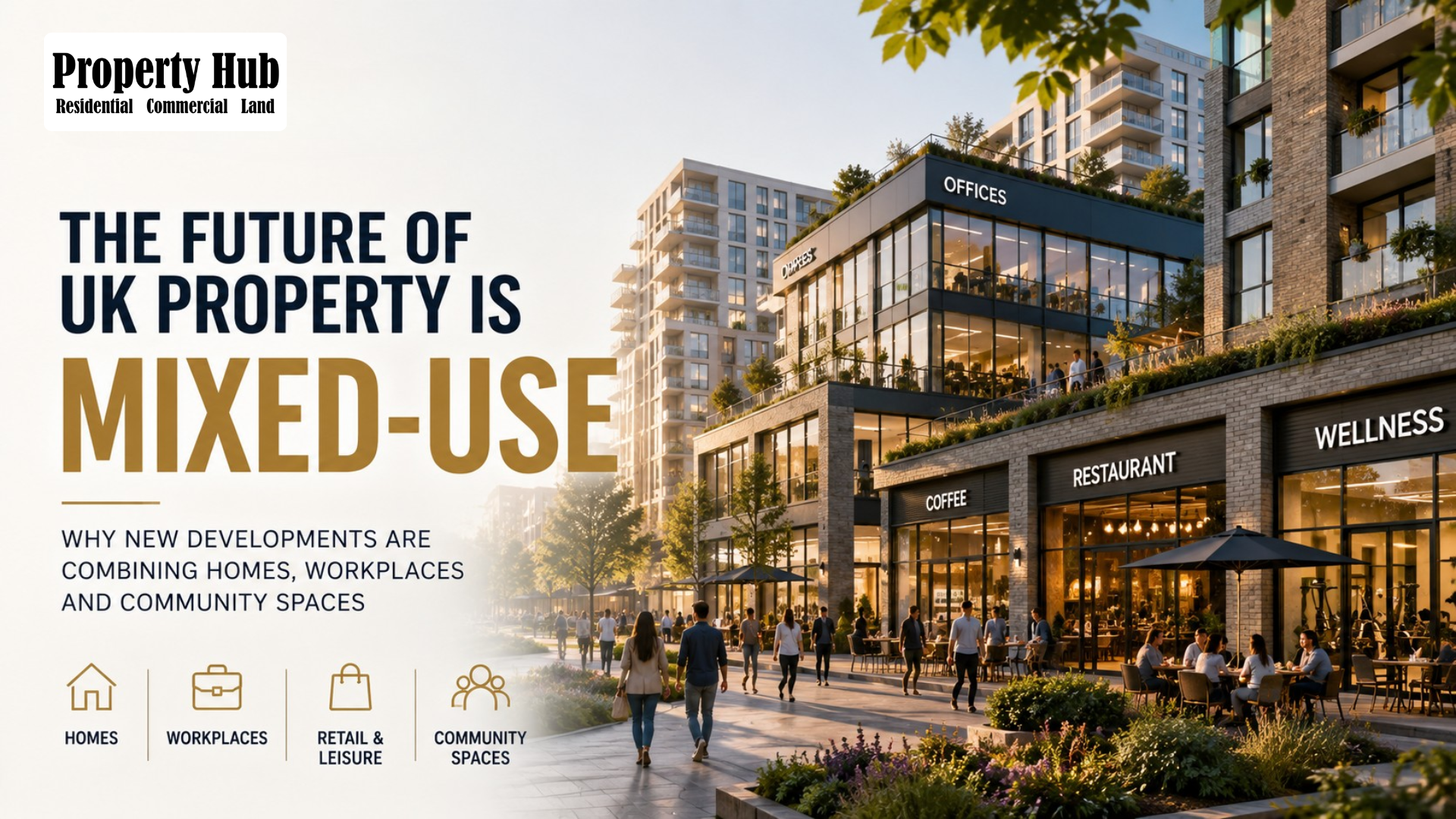
Increasingly, developers, councils and policymakers are exploring developments where people can live, work, shop, eat, exercise, access services and spend their leisure time within the same neighbourhood.
This is the idea behind mixed-use development.
Instead of creating residential estates that become quiet after working hours, or commercial districts that empty at the end of the working day, mixed-use developments attempt to create places that remain active throughout the day.
The concept is becoming increasingly relevant as the UK faces several interconnected challenges:
A shortage of homes.
Pressure on town centres.
Changing retail habits.
Hybrid and flexible working.
Demand for better public transport.
Pressure to use land more efficiently.
Need for regeneration.
Demand for healthcare and community services.
The changing role of the traditional high street.
Recent planning-policy developments in England are also putting greater emphasis on making more effective use of land, supporting town-centre diversification and creating places where housing can exist alongside employment, retail and community facilities.
So what exactly is mixed-use development?
And could it become one of the defining trends of the UK's property market over the next decade?
What Is Mixed-Use Development?
A mixed-use development is a development that combines different types of property and land uses within the same project or neighbourhood.
For example, a single development could contain:
Residential apartments.
Houses.
Offices.
Shops.
Restaurants.
Cafés.
Gyms.
Healthcare facilities.
Schools or nurseries.
Community centres.
Public spaces.
Parks.
Leisure facilities.
Cultural spaces.
The objective isn't simply to put different buildings next to one another.
The more ambitious approach is to create a connected neighbourhood where the different uses support each other.
Imagine leaving your apartment in the morning.
You walk downstairs.
There is a café on the ground floor.
A short walk away is your workplace.
Your child attends a nursery within the development.
There is a supermarket nearby.
A GP or healthcare facility is accessible without a long journey.
In the evening, you can use a gym, restaurant or public square.
You may not need to drive anywhere for many of your everyday activities.
That is the basic idea.
The development becomes a place to live, work and spend time—not simply a collection of buildings.
Why Is Mixed-Use Development Becoming More Important?
There isn't one single reason.
Several major changes are happening simultaneously.
1. The UK Needs More Homes
England continues to face significant pressure to increase housing supply.
The government's planning agenda has increasingly focused on making better use of land and supporting housing delivery.
The proposed changes to England's National Planning Policy Framework have included policies around more efficient land use, higher-density development in appropriate locations and diversification of town centres, including opportunities for additional residential accommodation.
This creates an important question:
Where should additional homes be built?
One answer is to use existing urban areas more efficiently.
Instead of expanding endlessly into new areas, some development can take place through the regeneration and intensification of existing commercial and town-centre locations.
That can mean transforming underused sites into mixed-use neighbourhoods.
2. Town Centres Are Changing
The traditional high street is no longer what it was.
Online shopping has transformed retail.
Working patterns have changed.
Office demand has evolved.
Consumers increasingly expect experiences rather than simply shops.
As a result, many town centres are looking for new purposes.
Housing can become an important part of that transformation.
Imagine an empty retail building being converted or redeveloped into:
Homes + cafés + healthcare + workspace + leisure + public space.
The result could be a town centre with more people living in it throughout the day.
That could create additional demand for local businesses.
The government's planning proposals have specifically recognised the need to diversify town-centre uses and create opportunities for residential accommodation.
3. Hybrid Working Has Changed the Meaning of "Workplace"
The traditional office model has also changed.
Many businesses have adopted hybrid or flexible working arrangements.
That doesn't necessarily mean offices are disappearing.
Instead, the relationship between home and workplace is changing.
People may work:
From home.
From an office.
From coworking spaces.
From cafés.
From shared community workspaces.
This creates opportunities for developments to provide flexible workspace close to residential areas.
Instead of commuting long distances every day, residents could potentially have access to workspace within their neighbourhood.
That could change the way developers think about residential schemes.
A future development might not simply ask:
"How many homes can we build?"
It could ask:
"What does this community need to function successfully?"
4. Transport and Property Are Becoming More Closely Connected
Location has always mattered in property.
But accessibility is becoming even more important.
The government's latest planning reforms are encouraging housing development in locations with good access to transport, including areas around train and tram stations.
That could accelerate the development of transport-oriented mixed-use communities.
A station doesn't simply need to be somewhere people board a train.
The surrounding area could become a destination containing:
Homes.
Offices.
Shops.
Restaurants.
Public spaces.
Healthcare.
Leisure.
Community facilities.
This can potentially create a more efficient relationship between transport, employment and housing.
The 15-Minute Neighbourhood Concept
Mixed-use development is closely connected to another urban-planning idea:
the 15-minute neighbourhood.
The basic principle is that residents should be able to reach many everyday necessities within a relatively short journey from home.
That doesn't mean everyone literally needs to live within exactly 15 minutes of everything.
Rather, it encourages planning around accessibility.
A successful neighbourhood could provide nearby:
Food shopping.
Education.
Healthcare.
Parks.
Employment.
Leisure.
Public transport.
Community facilities.
This can reduce unnecessary travel and potentially create more active neighbourhoods.
Homes Are No Longer Being Designed in Isolation
One of the biggest changes in property development is the shift from thinking about individual buildings to thinking about places.
A house can be beautifully designed.
An apartment can have excellent interiors.
But the surrounding environment still matters.
Buyers may ask:
What's nearby?
How long is the commute?
Where is the nearest supermarket?
Are there cafés and restaurants?
Are there parks?
What are the transport links?
Where can children play?
Are healthcare services accessible?
These questions can influence how attractive a development becomes.
What Does a Successful Mixed-Use Development Look Like?
There is no single formula.
But successful projects often combine several elements.
Residential
Apartments and houses provide the population.
Employment
Offices, studios and workspace provide jobs.
Retail
Shops and everyday services meet local needs.
Food and Hospitality
Restaurants, cafés and bars can create activity.
Healthcare
GP practices, pharmacies and other services can make neighbourhoods more self-sufficient.
Education
Nurseries, schools and learning facilities can support families.
Leisure
Gyms, sports facilities and entertainment can create additional reasons to stay locally.
Public Realm
Squares, parks, streets and pedestrian areas connect everything together.
Why Public Space Matters
A mixed-use development isn't successful simply because different buildings exist.
The spaces between the buildings matter enormously.
A poorly designed development can contain homes, shops and offices but still feel disconnected.
A successful development can create:
Attractive pedestrian routes.
Green spaces.
Public squares.
Seating areas.
Children's play areas.
Cycle routes.
Trees and landscaping.
Outdoor dining.
Community gathering spaces.
These areas can create identity.
They can also encourage people to spend more time outside their homes.
The Importance of Community
A development should ideally create more than property.
It should create community.
That means considering who will use the development and how people will interact.
For example:
A public square can host events.
A community centre can provide activities.
A café can become an informal meeting place.
A park can become a space for families.
A workspace can support local businesses.
A nursery can help working parents.
A healthcare facility can provide essential services.
These aren't simply "extra features".
They can help make a neighbourhood function.
Mixed-Use Development and Property Values
Could mixed-use developments influence property values?
Potentially.
Buyers often place value on convenience and accessibility.
A home close to:
Transport.
Shops.
Restaurants.
Employment.
Schools.
Parks.
Healthcare.
can be attractive to certain buyers.
However, proximity isn't automatically positive.
The quality and design of the surrounding development matters.
A noisy nightclub directly beneath a residential apartment may be undesirable.
A carefully designed café or restaurant may enhance the environment.
The relationship between uses is therefore crucial.
Not Every Mixed-Use Development Works
Mixed-use development isn't a magic solution.
There are genuine challenges.
Noise
Residential properties located above commercial uses may experience noise.
Deliveries
Shops and restaurants require deliveries.
Poorly planned servicing can create congestion.
Parking
Different uses can create competing demand for parking.
Privacy
Residents may want privacy from public areas.
Security
A development with many different users needs carefully considered security.
Management
Shared spaces and multiple property uses can create complex management requirements.
Service Charges
Residents may face costs associated with maintaining communal facilities.
Good design and professional management are therefore essential.
The Role of Property Management
Mixed-use developments can be more complicated than conventional residential developments.
There may be:
Residential leaseholders.
Tenants.
Commercial occupiers.
Retailers.
Office workers.
Visitors.
Contractors.
Community organisations.
Each group has different requirements.
Property management therefore becomes particularly important.
A well-managed development needs clear systems for:
Maintenance.
Cleaning.
Security.
Waste management.
Repairs.
Shared spaces.
Service charges.
Communication.
Health and safety.
The physical design may attract residents.
Management helps determine their long-term experience.
Could Empty High Streets Become Housing?
This is one of the most interesting opportunities.
The UK has many commercial properties that no longer serve their original purpose effectively.
Some retail spaces are too large.
Some office buildings are underused.
Some shopping centres require regeneration.
Some town-centre sites have significant redevelopment potential.
Converting or redeveloping these locations could create opportunities for housing while also supporting town-centre regeneration.
But conversion isn't always straightforward.
Buildings may require:
Structural changes.
Natural-light improvements.
New services.
Fire-safety upgrades.
Accessibility improvements.
Energy-efficiency improvements.
Planning approval.
The economics need to work.
From Shopping Centres to New Communities
Some of the UK's largest regeneration projects demonstrate this changing approach.
Nottingham's former Broad Marsh site, for example, is being repositioned as part of a wider city-centre regeneration strategy. Homes England has been seeking a developer to help create a new city quarter involving around 1,000 homes alongside a commercial district.
That illustrates the broader direction.
A former retail destination can potentially become something much more diverse:
Homes + employment + commerce + public realm.
The future of regeneration may therefore involve rebuilding entire neighbourhoods rather than simply replacing individual buildings.
Mixed-Use Development Can Support Local Economies
One of the strongest arguments for mixed-use development is economic activity.
More residents can mean more customers.
More businesses can mean more jobs.
More workers can mean more daytime spending.
More visitors can support restaurants and leisure.
This can create a cycle:
Homes → People → Businesses → Jobs → Services → More Attractive Place
It doesn't always work automatically.
But where the combination is carefully planned, different uses can support one another.
The "Live, Work, Play" Model
The phrase "live, work and play" has become increasingly common in property development.
The idea is simple:
A successful neighbourhood shouldn't only provide somewhere to sleep.
It should provide opportunities to:
Live.
Work.
Shop.
Relax.
Exercise.
Meet people.
Access services.
That doesn't mean every development needs every possible facility.
Instead, the mix should reflect the local population.
Families Need Different Things
A mixed-use development designed for young professionals may prioritise:
Restaurants.
Gyms.
Coworking.
Transport.
Cafés.
A family-focused development might prioritise:
Schools.
Nurseries.
Parks.
Healthcare.
Supermarkets.
Play areas.
An older residents' community might prioritise:
Healthcare.
Accessible housing.
Green spaces.
Community facilities.
Local shops.
Public transport.
The best developments therefore begin with the question:
Who will live here?
Sustainability and Mixed-Use Development
There is also an environmental argument.
If homes, jobs and services are closer together, people may have fewer reasons to make long journeys by car.
Mixed-use planning can potentially support:
Walking.
Cycling.
Public transport.
Lower car dependency.
Efficient use of infrastructure.
Reuse of previously developed land.
England's planning framework has long encouraged making effective use of land and seeking multiple benefits from development, including through mixed-use schemes.
The newer planning direction goes further in considering how housing, employment, education and community facilities can be integrated.
What About Green Space?
Mixed-use does not mean covering every available piece of land with buildings.
Quite the opposite.
Modern developments increasingly need to consider green infrastructure.
That can include:
Parks.
Pocket parks.
Trees.
Green corridors.
Community gardens.
Biodiversity areas.
Sustainable drainage.
Landscaped public squares.
Green space can improve the experience of living in higher-density areas.
Higher Density Doesn't Have to Mean Lower Quality
One criticism of urban development is that increasing density could create overcrowded environments.
But density and quality aren't necessarily opposites.
A well-designed high-density neighbourhood can potentially provide:
Better public transport.
More local services.
More walkable streets.
Better public spaces.
More housing choices.
The challenge is ensuring that additional homes are supported by appropriate infrastructure.
That means planning for:
Homes + Roads + Transport + Schools + Healthcare + Parks + Utilities + Community facilities.
Infrastructure Is the Key
You cannot simply build thousands of homes and assume a community will automatically appear.
Infrastructure must grow with the population.
A new development may require:
Roads.
Public transport.
Schools.
Healthcare.
Drainage.
Utilities.
Broadband.
Parks.
Community facilities.
This is why planning authorities increasingly look at developments as systems rather than isolated buildings.
A New Approach to Brownfield Land
Brownfield land could play an important role.
These are sites that have previously been developed.
Examples can include:
Former industrial land.
Disused commercial sites.
Former retail locations.
Redundant office buildings.
Previously developed urban land.
Redeveloping such sites can potentially provide housing without creating entirely new settlements.
The government's planning framework has emphasised making effective use of previously developed land while meeting environmental and community objectives.
The Rise of Urban Regeneration
Regeneration may become one of the most important areas of the UK property industry.
Rather than simply building new housing estates on the edge of towns, developers are increasingly looking at opportunities to transform existing areas.
That can mean:
Old industrial area → New neighbourhood
Empty shopping centre → Homes + retail + leisure
Underused office district → Residential + workspace
Transport hub → Mixed-use urban centre
High street → Housing + healthcare + hospitality + community
The possibilities are significant.
What Does This Mean for Investors?
Mixed-use development can create different investment opportunities.
Investors may participate through:
Residential property.
Commercial property.
Development land.
Regeneration projects.
Build-to-rent.
Purpose-built rental housing.
Commercial units.
Property funds.
But mixed-use investment can also be more complex.
Commercial leases work differently from residential tenancies.
Service charges can be different.
Vacancy risk can vary.
Management requirements can be more complicated.
Professional advice and due diligence are essential.
What Does This Mean for Homebuyers?
For buyers, mixed-use developments can offer convenience.
Potential benefits could include:
Nearby amenities.
Better transport.
Walkability.
Local employment.
Restaurants and cafés.
Community facilities.
Green spaces.
But buyers should investigate the development carefully.
Ask:
What commercial businesses are planned?
What are the service charges?
Who manages the development?
Are there commercial units underneath the apartment?
What noise could be generated?
What facilities are actually guaranteed?
Could the commercial units change use in the future?
What is the long-term management structure?
These questions can be particularly important when purchasing a leasehold property.
What Does This Mean for Estate Agents?
The shift towards mixed-use communities also creates opportunities for estate agents.
Agents may increasingly need to understand not just individual properties but the wider development ecosystem.
A buyer may be interested in:
The apartment.
The neighbourhood.
Transport.
Amenities.
Rental demand.
Future development.
Local employment.
Property marketing therefore becomes more about lifestyle and location.
The question isn't simply:
"How many bedrooms does this property have?"
It can become:
"What kind of life does this location enable?"
The Future of the High Street
The high street may be one of the biggest beneficiaries of mixed-use thinking.
Rather than trying to recreate the retail model of the past, future town centres could become more diverse.
Imagine:
Homes above shops.
Offices beside cafés.
Healthcare beside restaurants.
Libraries beside workspaces.
Parks surrounded by housing.
Community centres connected to transport hubs.
This could create town centres that remain active beyond traditional shopping hours.
Current debate around high-street regeneration is increasingly focused on moving beyond retail and creating places that combine housing, healthcare, community services, workspaces and leisure.
The Pub, Community and Property Debate
Recent planning developments also demonstrate the tension between development and community identity.
The government has moved to strengthen protection for pubs in England against conversion into housing or commercial uses, arguing that community institutions should not automatically disappear simply because land values make redevelopment attractive.
This highlights an important principle:
Regeneration should not mean removing everything that makes a place distinctive.
The strongest mixed-use developments need to balance:
Growth + Housing + Business + Community + Identity.
Could Mixed-Use Developments Change the Way We Define "Home"?
Possibly.
Historically, a home was primarily considered the private space inside your property.
The future may place greater emphasis on the neighbourhood surrounding it.
A resident may value:
A shared garden.
A coworking lounge.
A gym.
A café.
A public square.
A community space.
Transport access.
Nearby services.
This doesn't mean private space becomes less important.
It means location and community become part of the property proposition.
The Risks Developers Need to Consider
Mixed-use schemes can fail if the different components aren't balanced.
For example:
Too many residential units and not enough services can create a dormitory-style neighbourhood.
Too much commercial space can create vacant units.
Too many restaurants can create noise and parking pressure.
Poor public space can make the development feel artificial.
Weak transport can increase car dependency.
Insufficient infrastructure can put pressure on local services.
Successful development therefore requires careful planning.
The Biggest Challenge: Creating a Real Community
Buildings are relatively easy to construct.
Communities are harder.
A developer can create:
Apartments.
Shops.
Offices.
Parks.
But those physical elements don't automatically create social connections.
Community can develop through:
Events.
Local businesses.
Public spaces.
Schools.
Clubs.
Markets.
Community organisations.
Accessible shared facilities.
This is where the difference between mixed-use development and successful placemaking becomes important.
What Could the UK Property Landscape Look Like in 2030?
By the end of the decade, we could see more developments built around several interconnected principles:
More homes in existing urban areas
Instead of relying entirely on outward expansion.
More residential town centres
Bringing people back into areas previously dominated by retail.
More transport-oriented development
Putting housing and employment close to rail, tram and other public transport.
More flexible commercial space
Designed around changing working patterns.
More community facilities
Healthcare, education and leisure becoming integral parts of development planning.
More green infrastructure
Public spaces becoming central rather than an afterthought.
More adaptive reuse
Turning obsolete buildings into new uses.
More integrated neighbourhoods
Designing entire communities rather than isolated housing blocks.
Is Mixed-Use the Future of UK Property?
There is a strong case that it will be an increasingly important part of the market.
The UK needs more homes.
Town centres need new economic models.
Businesses need flexible space.
Residents want convenience.
Local authorities need regeneration.
Developers need to make effective use of land.
Transport infrastructure needs to connect people with jobs and services.
Mixed-use development sits at the intersection of all these challenges.
But success will depend on quality.
The future isn't simply about putting more buildings on the same piece of land.
It is about creating places that work.
Final Thoughts
The future of UK property may not be defined by the number of homes built.
It may be defined by the quality of the places created around those homes.
A successful development could combine:
Homes.
Work.
Retail.
Healthcare.
Education.
Leisure.
Green space.
Transport.
Community.
The objective is simple:
Create places where people don't just live—but actually want to spend their lives.
The latest planning direction in England is increasingly supportive of making better use of land, diversifying town centres and integrating housing with employment and community uses.
Recent projects also demonstrate how major regeneration schemes are moving towards broader "city quarter" and neighbourhood models rather than single-purpose developments. Nottingham's Broad Marsh regeneration, for example, is being positioned around housing alongside a wider commercial district.
For buyers, this could mean more choice.
For investors, it could create new opportunities.
For developers, it creates new challenges.
For estate agents, it means selling not only properties but places and lifestyles.
And for communities, the biggest opportunity is perhaps the most important one of all:
A new generation of UK developments could bring housing, employment and everyday life closer together.
The property industry has spent decades asking:
"What should we build?"
The next generation may need to ask a more important question:
"What kind of place are we creating?"
Property Hub Ltd — Your Property. Our Priority.
This article is for general information and editorial purposes only. Planning policy, development proposals and property markets can change. Buyers, investors and developers should obtain appropriate independent legal, financial, planning and professional advice before making decisions.