RMC Management Explained: What Is a Residents’ Management Company and How Does It Work?
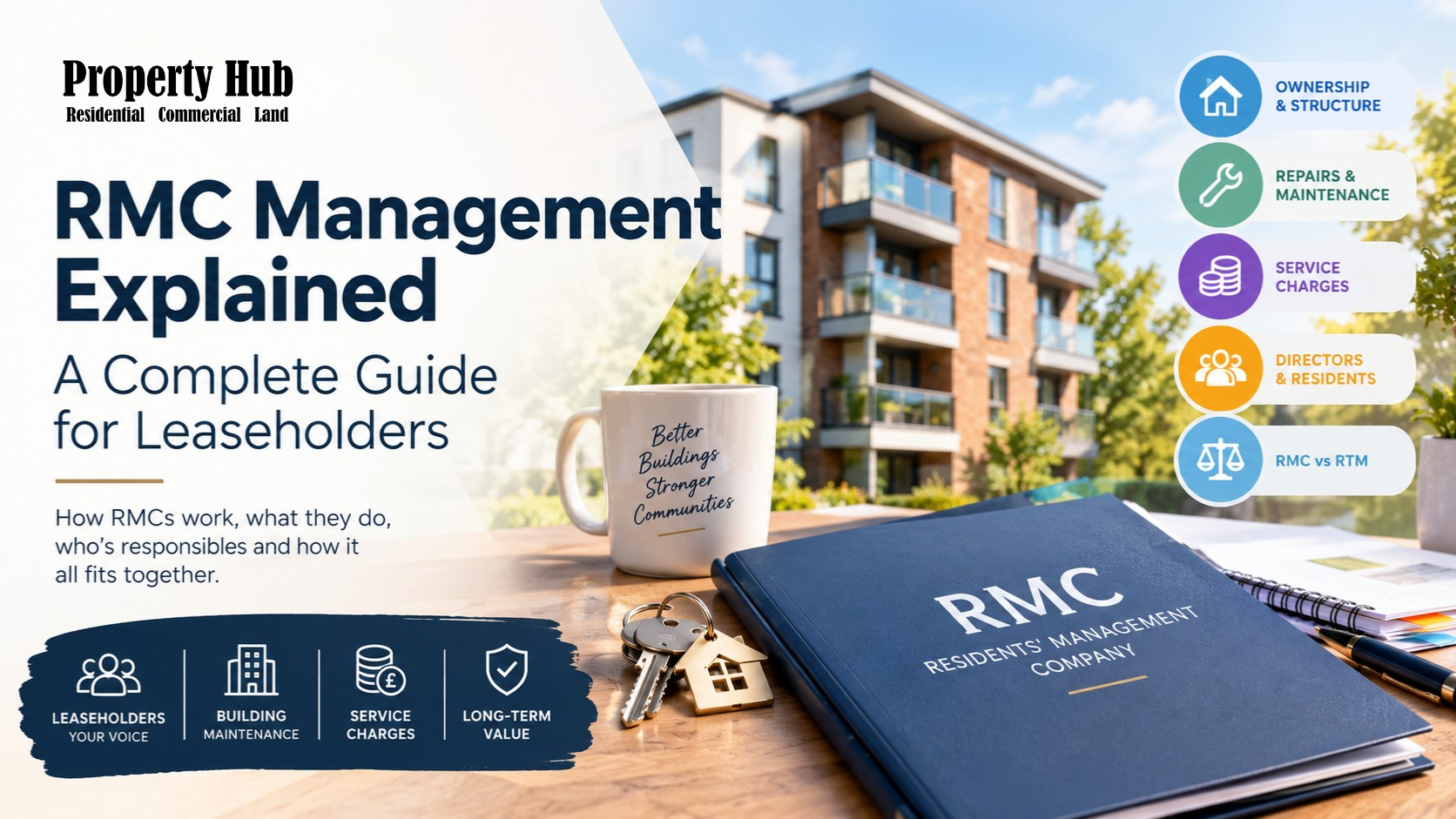
If you own a leasehold flat, you may have come across the term RMC in your lease, service-charge documents or property-management correspondence.
RMC stands for Residents’ Management Company.
But what does an RMC actually do?
Who controls it?
Who pays for the building's maintenance?
What responsibilities do the directors have?
And, perhaps most importantly, how is an RMC different from a Right to Manage (RTM) company?
These questions matter because the management structure of a block can affect everything from communal repairs and insurance to service charges, contractors, building safety and the day-to-day experience of living in the development.
An RMC is generally a company connected to the leasehold structure of a building, with leaseholders typically holding shares or membership in the company. Its precise responsibilities depend on the leases, company structure and arrangements for the particular development.
In many cases, an RMC is responsible for managing or arranging the management of the building's communal areas, structure and services.
For leaseholders, understanding how the company works can make it much easier to understand who is responsible for what.
The RMC in Simple Terms
Think of an RMC as the organisation responsible for helping manage a residential development on behalf of its leaseholders.
Depending on the property's legal structure, the RMC may have responsibilities relating to:
- Communal areas.
- Building maintenance.
- Repairs.
- Cleaning.
- Gardening.
- Building insurance.
- Contractors.
- Service-charge administration.
- Compliance.
- Long-term maintenance.
- Building management decisions.
The exact responsibilities should not be assumed.
The lease is critical.
Government guidance describes an RMC as a company that is a party to the lease and whose shares are owned by leaseholders, with RMCs usually having responsibility for repair obligations.
That means two buildings can both have an RMC but operate slightly differently.
Why Do RMCs Exist?
Large residential developments need somebody to organise the practical running of the building.
Someone has to arrange for the communal areas to be cleaned.
Someone needs to deal with repairs.
Someone needs to organise contractors.
Someone may need to arrange buildings insurance.
Someone needs to keep financial and company records.
And major decisions about the building need to be made.
An RMC can provide the corporate structure through which those responsibilities are handled.
In many developments, leaseholders have an ownership or membership interest in the company and can therefore have a say in how the building is managed.
The Leasehold Advisory Service explains that RMCs are commonly established by developers for new-build flats, with arrangements often included in the lease or handover arrangements.
RMC vs Freeholder vs Managing Agent
One of the biggest sources of confusion is assuming that these three roles are the same.
They are not.
Freeholder
The freeholder owns the freehold interest in the building or development.
RMC
The Residents’ Management Company is the company responsible for particular management obligations under the property's legal arrangements.
Managing Agent
A managing agent is a professional company appointed to carry out day-to-day management work.
The RMC may appoint a managing agent to carry out much of the practical work.
That does not necessarily mean the managing agent owns the building.
The Leasehold Advisory Service explains that property managers can act on behalf of a landlord, RMC, RTM company or other ownership structure.
A useful way of thinking about it is:
Ownership → Management Structure → Day-to-Day Management
The legal documents determine who sits where in that structure.
What Does an RMC Actually Manage?
The answer depends on the lease and the company's responsibilities.
However, an RMC may commonly be involved with areas such as:
The Communal Areas
This can include:
- Entrance halls.
- Corridors.
- Staircases.
- Communal lighting.
- Shared doors.
- Lifts.
- Bin stores.
- Shared gardens.
- Parking areas.
- Other communal facilities.
The objective is to keep shared parts of the development safe, functional and properly maintained.
Repairs Are a Major Part of the Job
Building maintenance is often one of the most visible responsibilities of an RMC.
Depending on the lease, this could involve:
- Roof maintenance.
- External walls.
- Communal windows.
- Drainage.
- Gutters.
- Communal plumbing.
- Electrical systems.
- Fire-safety systems.
- Lifts.
- Communal doors.
- External decoration.
However, responsibility can differ between buildings.
A lease may divide repairing responsibilities between the freeholder, RMC, leaseholders and other parties.
That is why a leaseholder should not assume that “the RMC manages the building” automatically means the RMC is responsible for every repair.
Who Runs an RMC?
An RMC is a company.
That means it generally operates through directors and members/shareholders, subject to its particular corporate structure.
The directors are responsible for making decisions on behalf of the company.
In resident-led arrangements, directors are often leaseholders themselves.
This can provide a major advantage:
The people making decisions can actually live in the building they are managing.
They may therefore have a direct interest in:
- Good maintenance.
- Reasonable expenditure.
- Effective contractors.
- Building appearance.
- Resident communication.
- Long-term property condition.
But being an RMC director is also a responsibility.
It is not simply an informal residents' committee.
Being an RMC Director Is More Serious Than It Looks
Residents sometimes volunteer to become directors because they want to improve their building.
That can be positive. But what are the responsibilities directors have as company directors?
They may need to deal with:
- Company administration.
- Financial decisions.
- Accounts.
- Company filings.
- Contracts.
- Insurance.
- Complaints.
- Maintenance.
- Conflicts of interest.
- Legal obligations.
- Building-safety responsibilities.
GOV.UK states that residents who become directors of a property management company have legal responsibilities and that companies must maintain their required Companies House filings, including annual accounts and confirmation statements.
In other words:
An RMC should be treated as a real company — because it is one.
Where Does the Money Come From?
This is where service charges enter the picture.
Leaseholders may be required under their leases to contribute towards the cost of maintaining and managing the building.
The money may be used for things such as:
- Cleaning.
- Gardening.
- Repairs.
- Insurance.
- Management.
- Maintenance contracts.
- Communal electricity.
- Lift servicing.
- Fire-safety work.
- Professional fees.
- Major works.
- Reserve funds.
The precise costs and payment mechanisms depend on the lease.
An RMC should therefore have clear financial administration and proper records.
Service Charges and the RMC
Service charges are one of the most important areas of residential block management.
Leaseholders want to know:
What am I paying for?
Why does it cost this much?
Who approved the expenditure?
Which contractor is being used?
Is the work necessary?
Has the building planned for future expenditure?
A well-managed RMC should have appropriate processes for budgeting, approving expenditure and communicating relevant information to leaseholders.
Leaseholders also have legal rights concerning service charges, and disputes can in some circumstances be considered by the First-tier Tribunal (Property Chamber).
The Importance of a Reserve Fund
Some buildings maintain a reserve or sinking fund.
The purpose is to prepare for significant future expenditure rather than requiring leaseholders to find the entire cost unexpectedly.
Potential future projects could include:
- Roof replacement.
- External decoration.
- Window replacement.
- Major electrical work.
- Lift replacement.
- External repairs.
- Major communal improvements.
A reserve fund can therefore be an important part of responsible long-term block management.
But whether a reserve fund exists, how it is collected and what it can be used for depends on the lease and the building's arrangements.
RMC Management Is About More Than Repairs
A modern residential block involves much more than fixing things when they break.
Effective management should consider:
Maintenance
Keeping the property in good condition.
Prevention
Identifying problems before they become expensive.
Compliance
Meeting relevant legal and regulatory requirements.
Financial planning
Preparing for routine and major expenditure.
Communication
Keeping leaseholders appropriately informed.
Risk management
Considering issues such as insurance, fire safety and building defects.
Long-term value
Protecting the quality and condition of the development.
Good block management is therefore not simply reactive.
It should be strategic.
What About Building Safety?
Building safety has become increasingly important in residential property management.
Depending on the building, its height, use, construction and legal structure, different regulatory responsibilities may apply.
RMCs and other building-management organisations can have obligations under the leasehold and building-safety framework.
GOV.UK guidance specifically addresses legal obligations involving building owners, RMCs, RTM companies and named managers in England.
This is an area where an RMC should obtain appropriate professional advice rather than attempting to interpret complex legislation without specialist support.
RMC or RTM?
This is one of the most important distinctions to understand.
RMC and RTM are not automatically the same thing.
A Residents’ Management Company is a company connected to the management arrangements of a development.
A Right to Manage company, meanwhile, is created by qualifying leaseholders to exercise a statutory right to take over management functions from the landlord.
The Right to Manage does not require leaseholders to prove that the landlord has mismanaged the building.
GOV.UK describes Right to Manage as a route through which qualifying leaseholders can take over management responsibilities without needing to prove bad management.
The Right to Manage in Plain English
Imagine a block where leaseholders are unhappy with the current management arrangements.
If the building and leaseholders meet the relevant legal requirements, they may potentially be able to exercise the Right to Manage.
This involves creating an RTM company and following the statutory process.
If successful, management responsibilities transfer to the RTM company.
The freeholder does not automatically lose ownership of the building.
Instead:
Ownership remains separate from management.
GOV.UK confirms that when RTM is successfully acquired, the RTM company takes over management while the landlord remains the owner.
RMC vs RTM: The Key Difference
| RMC | RTM Company |
|---|---|
| Often established as part of the development's original management structure | Created by qualifying leaseholders exercising a statutory right |
| Responsibilities depend heavily on the lease and corporate structure | Takes over defined management functions through the statutory RTM process |
| May manage the building directly | Can manage directly or appoint a managing agent |
| Leaseholders may be members/shareholders | Qualifying leaseholders become members under the RTM structure |
| Common in new-build developments | Used when leaseholders want to take over management |
The two structures can overlap in practical terms, but they should not be treated as interchangeable legal concepts.
Can an RMC Appoint a Professional Managing Agent?
Yes, depending on its structure and authority.
In fact, many resident-led management companies use professional managing agents.
This can make sense because professional block management can involve:
- Contractor management.
- Service-charge administration.
- Accounts.
- Insurance.
- Compliance.
- Maintenance.
- Resident communication.
- Major works.
- Health and safety.
- Record keeping.
The RMC can retain responsibility for strategic decisions while the managing agent handles day-to-day administration.
The Leasehold Advisory Service notes that RMCs and RTM companies often delegate management tasks to professional property managers.
Why Professional Management Can Matter
Running a residential block is very different from managing a single house.
A block may have:
- Multiple leaseholders.
- Complex leases.
- Shared services.
- Contractors.
- Service charges.
- Insurance arrangements.
- Fire-safety requirements.
- Long-term maintenance obligations.
- Legal correspondence.
- Accounting requirements.
A professional managing agent can provide the infrastructure and expertise required to coordinate these responsibilities.
But professional management should not mean residents lose visibility.
The RMC should still understand what is happening and monitor the agent's performance.
The Leasehold Advisory Service specifically notes that appointing a property manager does not remove the RMC or RTM company's responsibility for decisions, policy and oversight.
What Should Leaseholders Look for in Good RMC Management?
Good management should be visible in the everyday experience of the building.
Look for:
Clear Communication
Residents should know who to contact and how issues are handled.
Preventative Maintenance
Problems should ideally be identified before they become emergencies.
Transparent Financial Management
Leaseholders should be able to understand how money is being spent.
Reliable Contractors
Contractors should be appropriately selected and monitored.
Proper Records
Important decisions, inspections, repairs and financial matters should be documented.
Long-Term Planning
The building should not be managed only from one repair to the next.
Professional Oversight
Where specialist knowledge is required, the RMC should use appropriately qualified professionals.
What Happens When Management Goes Wrong?
Poor management can become obvious quickly.
You might notice:
- Repeated unresolved repairs.
- Poor communal cleaning.
- Unclear service-charge expenditure.
- Delayed communication.
- Poor contractor performance.
- Lack of maintenance planning.
- Deteriorating communal areas.
- Confusion over responsibilities.
But frustration alone does not always tell you what the legal solution is.
The first step is to understand the management structure.
Ask:
Who owns the building?
Who is the RMC?
Who are the directors?
Who is the managing agent?
What does the lease say?
Who is responsible for the particular issue?
Those questions can reveal where the problem actually sits.
What Should a Leaseholder Check?
If you have recently purchased a leasehold property, take time to understand the documents.
Useful information can include:
- Your lease.
- RMC company information.
- Service-charge statements.
- Recent accounts.
- Buildings insurance information.
- Major works notices.
- Management correspondence.
- Contact details for the managing agent.
- Details of planned maintenance.
- Information about reserve funds.
- Relevant building-safety information.
You do not need to understand every legal clause immediately.
But you should know where the important information is.
Buying a Flat With an RMC
For buyers, the RMC can be an important part of due diligence.
Before purchasing, consider asking:
Who manages the building?
Is there an RMC?
Who are the directors?
Is there a professional managing agent?
How much is the service charge?
Are there arrears?
Is there a reserve fund?
Are major works planned?
Are there outstanding disputes?
Are there building-safety issues?
What does the lease say about repairing obligations?
The answers can help you understand not just the flat itself, but the organisation responsible for the wider building.
RMC Management and Property Value
A well-maintained building can create a better environment for residents and potentially support buyer confidence.
Consider two otherwise similar flats.
One is located in a well-maintained development with:
- Clean communal areas.
- Good maintenance.
- Professional management.
- Clear financial records.
- Well-presented entrances.
- Reliable lifts.
- Attractive landscaping.
The other is in a building with:
- Persistent repairs.
- Poor communal presentation.
- Unclear management.
- Repeated complaints.
- Major maintenance concerns.
The management structure can therefore matter to more than just day-to-day convenience.
It can become part of the overall ownership experience.
The RMC's Relationship With Residents
Good communication should work in both directions.
Leaseholders should report genuine problems promptly.
The RMC or managing agent should have appropriate procedures for dealing with those reports.
For example:
Resident reports problem
↓
Issue is recorded
↓
Responsibility is established
↓
Contractor or professional is appointed where required
↓
Work is completed
↓
Issue is closed and recorded
This creates accountability.
A Building Is a Long-Term Asset
One of the biggest mistakes in block management is focusing only on today's problems.
A roof does not suddenly become a problem on the day it fails.
A lift does not become old overnight.
External decoration does not become necessary without warning.
A responsible management strategy looks ahead.
That means considering:
- Maintenance cycles.
- Reserve funds.
- Planned works.
- Contractor performance.
- Insurance.
- Building condition.
- Compliance.
- Future expenditure.
The objective is not simply to keep the building functioning this month.
It is to maintain the asset over many years.
When an RMC Works Well
A successful RMC can give leaseholders something valuable:
A meaningful voice in the management of their building.
Instead of management being completely distant from residents, leaseholders can have a role in the company structure and, depending on the arrangements, influence decisions about how their development is maintained.
That can create a stronger sense of accountability.
But it requires organisation.
An RMC works best when directors understand their responsibilities, residents communicate constructively and professional support is brought in where necessary.
RMC Management: The Questions Everyone Should Ask
If you are a leaseholder, ask:
Who manages my building?
Is there an RMC?
What does the lease say the RMC is responsible for?
Who are the directors?
Is a managing agent appointed?
How are service charges calculated?
Is there a reserve fund?
What major works are expected?
Who handles repairs?
Who arranges insurance?
What building-safety responsibilities apply?
How can I raise a complaint?
Understanding the answers can make leasehold ownership much less confusing.
Frequently Asked Questions
What does RMC stand for?
RMC stands for Residents’ Management Company.
It is a company connected to the management arrangements of a residential development, with leaseholders commonly holding shares or membership depending on the company's structure.
Is an RMC the same as a managing agent?
No.
An RMC is a management company. A managing agent is a professional organisation that may be appointed by the RMC to carry out day-to-day management work.
Does an RMC own the building?
Not necessarily.
The ownership structure depends on the particular development. An RMC may have management responsibilities without being the freeholder.
Are RMC directors usually residents?
They often are, although the exact arrangements depend on the company's articles, lease and development structure.
Does an RMC collect service charges?
An RMC may have responsibility for service-charge administration, either directly or through a managing agent, depending on the management structure and lease.
Can an RMC appoint a managing agent?
Yes, where its legal and corporate arrangements permit it. Many RMCs use professional managing agents to handle day-to-day operations.
What is the difference between RMC and RTM?
An RMC is a residents' management company connected to a property's management structure. RTM is a statutory right allowing qualifying leaseholders to take over certain management functions from the landlord through an RTM company.
Can an RMC be changed?
The options depend on the company's structure, lease and circumstances. Professional legal or leasehold advice may be appropriate where residents are considering significant changes.
Does every leasehold flat have an RMC?
No. Leasehold properties can have different ownership and management structures.
Why should buyers care about an RMC?
Because the management of the wider building can affect service charges, maintenance, communal areas, major works, building condition and the overall ownership experience.
The Bottom Line
An RMC is more than a name appearing on a service-charge statement.
It can sit at the centre of how a residential development is maintained, managed and planned for the future.
For leaseholders, understanding the RMC can help answer some of the most important questions about apartment ownership:
Who is responsible?
Who makes decisions?
Where does the money go?
Who arranges repairs?
Who manages the managing agent?
What happens when major work is required?
The answers will ultimately depend on the individual building, its lease, company structure and applicable law.
But the principle is simple:
Good residential management requires clear responsibility, proper planning and accountable decision-making.
At Property Hub Ltd, professional block management is about more than reacting when something goes wrong. It is about helping buildings operate efficiently, maintaining standards, supporting leaseholders and protecting the long-term quality of the property.
For developments considering professional block management, understanding your existing RMC structure is an important place to start.
Important Disclaimer
This article is intended for general information and educational purposes only. Leasehold, company, service-charge and building-safety responsibilities can vary according to the lease, company structure, development and jurisdiction. The legal position can also change. The information above should not be treated as legal, financial or specialist property-management advice. Leaseholders, RMC directors and prospective buyers should review the relevant lease and company documents and obtain independent professional advice where appropriate.