Block Management Compliance: Are You Managing Your Building Correctly?
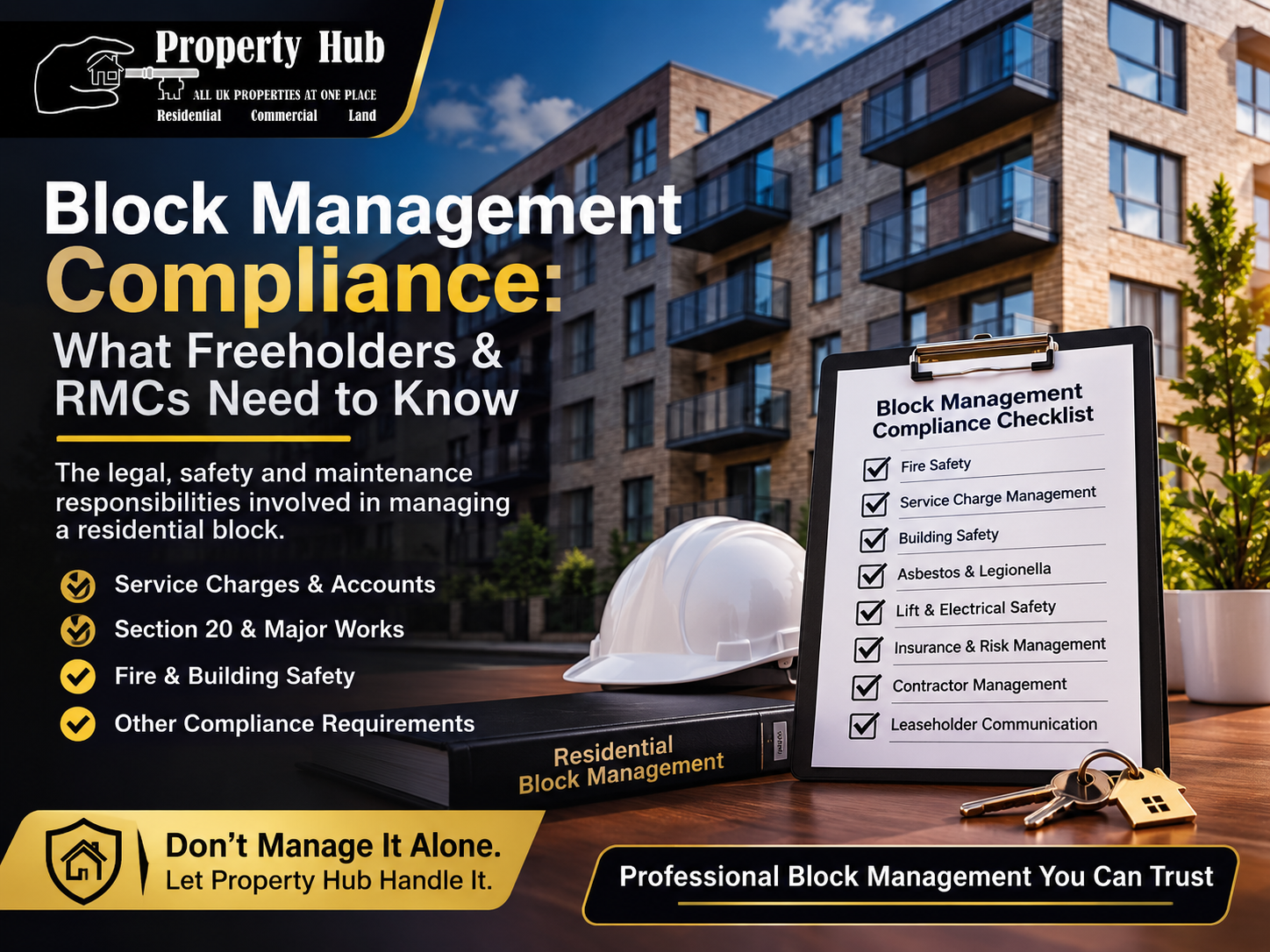
Managing a block of flats is much more than collecting service charges and arranging repairs.
For freeholders, Resident Management Companies (RMCs) and Right to Manage (RTM) companies, professional block management involves financial management, leasehold law, fire and building safety, contractor management, major works, insurance, maintenance and resident communication.
And the rules are continuing to change.
If you are managing your own block, how confident are you that everything is being handled correctly?
What Does Block Management Compliance Actually Involve?
There is no single piece of legislation called the “Block Management Act”. Instead, professional block management sits across a wide range of laws, regulations, codes and contractual obligations.
The exact requirements depend on the building, its lease, height, construction, facilities and use.
However, a professionally managed block may need to consider:
1. Service Charges & Financial Management
Service charges are one of the most important areas of leasehold management.
Management can involve:
-
Preparing annual budgets
-
Issuing service-charge demands
-
Monitoring expenditure
-
Managing arrears
-
Maintaining accounting records
-
Managing reserve or sinking funds
-
Preparing year-end accounts
-
Explaining expenditure to leaseholders
-
Ensuring costs are permitted by the lease
The Landlord and Tenant Act 1985 provides important protections around service charges, including requirements concerning reasonableness and the quality of services and works.
This means a managing agent needs to understand both the lease and the legislation before deciding what can be charged to leaseholders.
2. Section 20 & Major Works
Planning to replace a roof, repair external walls, carry out major decoration or undertake substantial building works?
You may need to follow the Section 20 consultation procedure under the Landlord and Tenant Act 1985.
Where qualifying works exceed the relevant statutory threshold, leaseholders may need to be consulted before the works proceed.
This can involve:
Notice of Intention → Estimates → Notice of Award
Getting the process wrong can potentially limit the amount recoverable from leaseholders.
And major works are not simply about getting three quotations.
A professional manager need to coordinate:
-
Surveys
-
Specifications
-
Contractor tendering
-
Leaseholder consultation
-
Contractor due diligence
-
Insurance checks
-
Health & safety
-
Project management
-
Contractor payments
-
Completion and warranties
This is one of the areas where professional management can make a significant difference.
3. Fire Safety & Building Safety
Following the Grenfell Tower tragedy, fire and building safety have become some of the most important responsibilities in residential block management.
The Fire Safety (England) Regulations 2022 introduced additional duties for responsible persons, including requirements concerning fire doors, resident information, fire-service information and, for relevant taller buildings, lifts, firefighting equipment, floor plans and secure information boxes.
Fire-safety management can involve:
-
Fire Risk Assessments
-
Fire doors
-
Emergency lighting
-
Fire alarms
-
Escape routes
-
Compartmentation
-
External walls
-
Evacuation arrangements
-
Resident communication
-
Remedial works
Importantly, appointing a managing agent does not automatically transfer the legal responsibility of the Responsible Person.
The owner, management company or RTM company may still have legal responsibilities even where an agent is appointed to manage the building.
That is why the management agreement and division of responsibilities need to be clear.
4. Higher-Risk Buildings & the Building Safety Act
For certain higher-rise residential buildings, the Building Safety Act 2022 introduces an additional layer of regulation.
In general terms, an occupied residential building can fall within the higher-risk building regime where it has at least 7 storeys or is at least 18 metres high and contains at least 2 residential units, subject to the detailed statutory criteria and exclusions.
For relevant buildings, Accountable Persons and Principal Accountable Persons have responsibilities relating to managing fire and structural safety risks.
This can involve:
-
Building registration
-
Building safety information
-
Safety case information
-
Resident engagement
-
Managing building safety risks
-
Reporting requirements
-
Building Assessment Certificates where applicable
The Building Safety Regulator is continuing to develop its approach in 2026. In July 2026, the BSR announced work towards a more proportionate and targeted approach to higher-risk building assessments while confirming that the underlying legal duties of Accountable Persons continue to apply.
For an RMC or RTM company, this can be a significant responsibility to manage without specialist support.
5. Asbestos, Legionella, Lifts & Other Safety Requirements
Fire safety is only one part of building compliance.
Depending on the building, management may also need to consider:
Asbestos
The duty to manage asbestos applies to the common parts of multi-occupancy domestic buildings, including areas such as corridors, staircases, lifts, roof spaces and garages. HSE guidance requires appropriate identification, assessment, recording and management of asbestos risks.
Water & Legionella
Water systems should be assessed and managed according to the risks present in the building.
Lifts
Lift maintenance and relevant thorough examinations need to be monitored, with defects followed up appropriately.
Electrical systems
Relevant communal electrical installations and equipment need appropriate inspection, maintenance and safety arrangements.
Gas
Where communal gas appliances or systems exist, appropriate gas-safety arrangements must be maintained.
The key point is that having a certificate is not the same as managing compliance.
A professional manager needs a system to know:
What is due?
When is it due?
Who is responsible?
What defects were identified?
Have they actually been fixed?
6. Contractor & Maintenance Management
A block manager may deal with dozens of contractors over the course of a year.
Cleaning.
Gardening.
Electrical works.
Roofing.
Plumbing.
Lift maintenance.
Fire safety.
Pest control.
Building repairs.
Major works.
The cheapest quotation is not necessarily the best quotation.
Professional contractor management should consider:
-
Competence
-
Public liability insurance
-
Employers' liability insurance where applicable
-
Relevant qualifications
-
Health & safety
-
Risk assessments
-
Method statements
-
References
-
Scope of works
-
Guarantees
-
Previous performance
For significant construction projects, the Construction (Design and Management) Regulations 2015 (CDM) may also need to be considered.
7. Insurance & Long-Term Maintenance
A block manager should not simply renew the building insurance every year and forget about it.
Management should consider:
-
Buildings insurance
-
Rebuild value
-
Policy exclusions
-
Claims
-
Excesses
-
Risk improvements
-
Lease requirements
Long-term maintenance is equally important.
A roof may be fine today but could require replacement in several years.
The same applies to:
-
External decoration
-
Rendering
-
Windows
-
Lifts
-
Roofing
-
Communal electrical systems
-
Fire-safety improvements
This is why reserve funds and planned maintenance can be so important.
Good block management tries to prevent expensive emergencies rather than constantly reacting to them.
8. What Has Changed in 2026?
This is where block management becomes particularly interesting.
The new RICS Service Charge Code
The 4th Edition of the RICS Service Charge Residential Management Code became effective on 7 April 2026.
The updated Code aims to improve standards, consistency and transparency in residential service-charge management and places greater emphasis on areas such as budgeting, financial management, procurement, communication, risk management, planned preventative maintenance and reserve funding where leases permit.
For professional managing agents, this is an important benchmark for how residential service charges should be managed.
Leasehold Reform is moving forward
The Leasehold and Freehold Reform Act 2024 continues to be implemented.
The government published a further response in July 2026 concerning reforms aimed at strengthening leaseholder protections around charges and services, including greater transparency and stronger protections against unfair costs.
The government has also published a Draft Commonhold and Leasehold Reform Bill, which proposes further major changes to the leasehold system and aims to make commonhold the default tenure for new flats.
For freeholders and managing agents, this means leasehold management is an area that cannot simply be left on autopilot.
The Renters' Rights Act has also changed the wider property-management landscape
From 1 May 2026, major changes under the Renters' Rights Act 2025 came into force for private rented properties in England, including the end of Section 21 possession notices for the relevant tenancies and changes to tenancy arrangements and enforcement.
While the Act primarily concerns the private rented sector rather than leasehold service-charge management, it is relevant to blocks where leaseholders are also landlords.
A block management company therefore needs to understand where leasehold management, property management and letting responsibilities overlap.
So, Can You Manage Your Block Yourself?
Yes, you can.
But the more important question is:
Should you?
Managing a block professionally can mean keeping track of:
Leasehold law
-
Service charges
-
Section 20
-
Fire safety
-
Building safety
-
Asbestos
-
Contractors
-
Insurance
-
Maintenance
-
Financial records
-
Resident communication
-
Changing legislation
And when you are a volunteer RMC director, leaseholder or freeholder, all of this is usually being managed alongside your normal work and personal commitments.
One missed deadline, expired certificate, poorly managed contractor or incorrectly handled major works project can create unnecessary cost and conflict.
Professional Block Management Takes the Pressure Away
At Property Hub Ltd, we manage residential blocks for freeholders, RMCs, RTM companies and property owners.
Our role is to provide the systems, organisation and professional oversight required to keep your building properly managed.
Our services can include:
✅ Service-charge management
✅ Financial administration
✅ Contractor management
✅ Planned & reactive maintenance
✅ Compliance monitoring
✅ Fire-safety coordination
✅ Section 20 & major works coordination
✅ Insurance administration
✅ Reserve-fund planning
✅ Leaseholder communication
✅ Building inspections
✅ RMC & RTM support
✅ Long-term maintenance planning
Do not wait until something goes wrong.
If you are currently self-managing your block or are unhappy with your existing managing agent, let us review your building and management arrangements.
Get a Free Block Management Review
Tell us about your building and we'll discuss how Property Hub could take the day-to-day management off your hands and give your residents, directors and owners greater confidence.
Property Hub Ltd
Established since 2008
📞 0208 903 1002
📧 info@propertyhubltd.com
🌐 www.propertyhubltd.com
Your building. Our expertise. Better managed.
Disclaimer: This article provides general information about residential block management in England and is not legal advice. Legislation and guidance can change, and individual buildings may have additional requirements depending on their lease, construction, height, use and circumstances. Professional legal, fire-safety, structural or other specialist advice should be obtained where appropriate.